
Here's a pattern from our sister brand Butlers in the Buff's over 20 years of booking records that surprises everyone: 56% of the year's group bookings are made between January and May, January is the single busiest booking month, and December is the quietest at just 2.9%. In other words, the groups who get first pick of 2026's best houses are deciding their destination right now — while everyone else is still recovering from Christmas.
Start with the trip, not the map
The mistake almost every first-time organiser makes is opening a map before agreeing what the weekend is for. Destination is the last decision, not the first, and it falls out of three answers you can get in a single message to the group.
What is the weekend actually for? A milestone birthday, a reunion, a hen or stag, a team offsite and a family gathering all want different things from a location. Is the house the venue, or a base? If the party happens at the property, remoteness is a feature and you should optimise for space, kitchen and garden. If people want to walk to a pub or a restaurant, you need a town and you should expect to pay for proximity. Where does everyone live? Plot the three or four postcode clusters your group comes from, and treat anything beyond a comfortable drive for the majority as a warning sign.
Answer those and the shortlist usually writes itself. What follows is how the main UK regions actually behave for groups.
The Cotswolds — when the house is the point
Honey-stone manors, firepits, dogs welcome, phones forgotten. The Cotswolds is the destination for groups who plan to arrive Friday and barely leave the grounds — and we mean that as the highest compliment.
It has the deepest supply of properties genuinely built for groups: long tables, multiple sitting rooms, gardens that can take a marquee or a firepit. That matters more than it sounds, because the single most common complaint about a group weekend is that everyone ended up in three different rooms. The trade-off is transport — village-to-village public transport is limited and rural taxis need arranging days ahead, so settle who is driving before you book.
The Lake District — the activity weekend
Cumbria Tourism counted 17.73 million visitors in 2024, so yes, Windermere gets busy. The trick is a Lake District house in a quieter valley: you get the fells at your door and hand the crowds back at teatime. Best for groups who want to earn their evening.
Only choose it if the group genuinely wants to be outside. A Lakes weekend booked for people who'd rather shop is a long drive to a rainy window. Where it excels is a group with a real range of energy levels — the walkers get their day out, the rest get a hot tub and a view, and everyone reconvenes for dinner with something to talk about.
Yorkshire — the value play
More square footage per pound than almost anywhere in England, proper pubs, and scenery that doesn't need a filter. Yorkshire is our quiet recommendation for first-time organisers on a committee budget, and our Yorkshire group accommodation planning guide covers the Dales, the Moors and the coast in detail.
The county's advantage for groups is that the same budget tends to buy more house — more bedrooms, more communal space, more grounds — which is exactly what a large party needs. It suits reunions and milestone birthdays particularly well, where the point is having everyone under one roof rather than being close to anything in particular.
The Peak District — the one nobody has to cross the country for
If your group is genuinely spread out, the Peak District solves the problem that ruins more group weekends than any other: people not coming because the journey is too long. Sitting between Manchester, Sheffield, Derby and the Midlands, it is within a manageable drive of a large share of the UK population.
You get stone farmhouses, walking, well-run pubs and dramatic scenery, with the practical advantage that a Friday-evening arrival is realistic for most people rather than a four-hour ordeal. For any group where attendance is the thing you're most worried about, this is the region I'd shortlist first.
Cornwall — the summer statement
Unbeatable in July, unbookable in August if you dawdle. Go for Cornwall — but only if your group can commit before spring, and only if you're willing to make it three nights rather than two. The journey is long enough that a two-night trip spends most of its value on the motorway.
Bath — the city-and-spa compromise
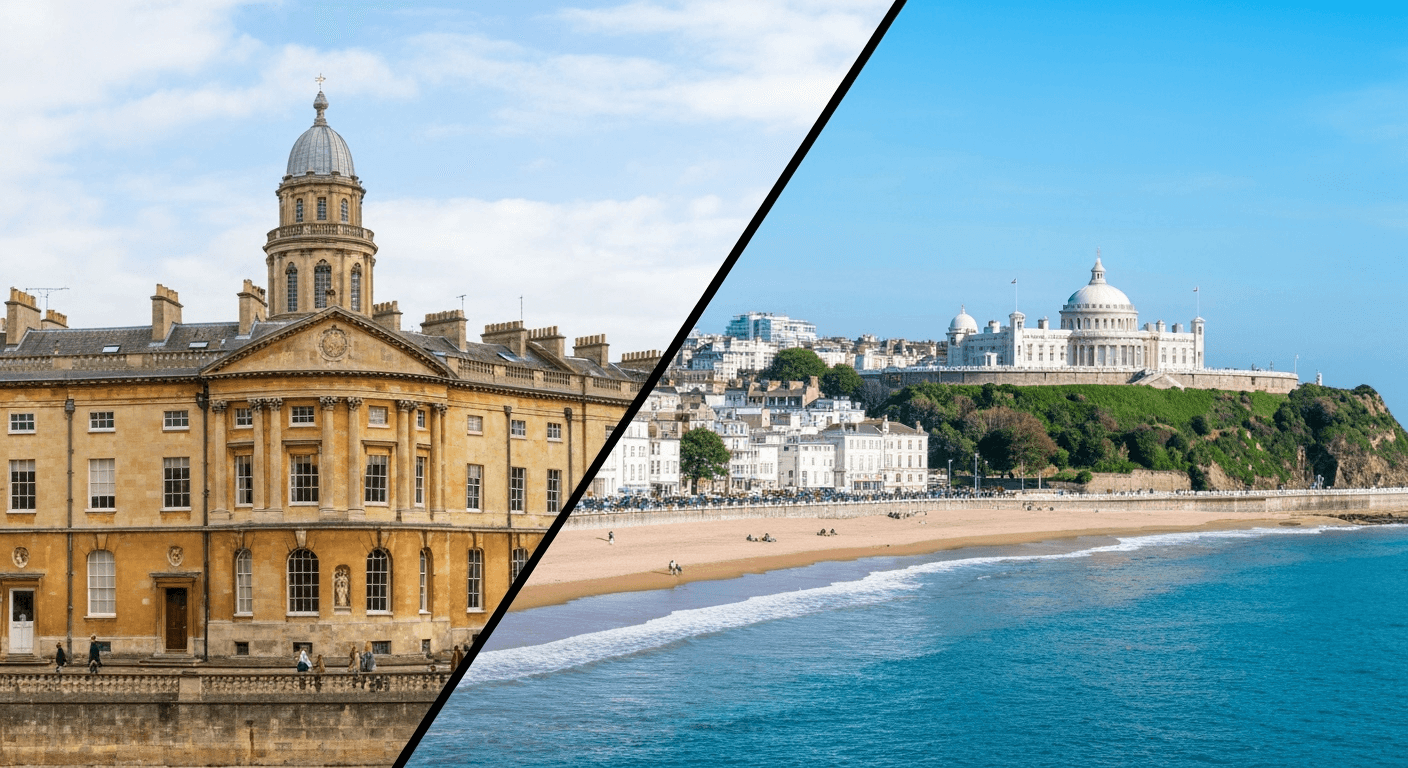
For the group that can't agree: half want culture and cocktails, half want a hot tub. Bath is the only UK destination that genuinely delivers both inside one postcode.
Its underrated quality is that nobody has to drive. The spa, the restaurants, the shops and the station are all inside a walkable centre, so a group staying centrally can get through an entire weekend without arranging transport once. For mixed-age groups and anyone who has ever tried to move a big group across a city at 11pm, that is worth a premium on its own.
Match the destination to the occasion
Different occasions fail in different ways, which is a more useful way to choose than ranking places by prettiness.
- Family reunions and multi-generational trips need step-free options, ground-floor bedrooms, somewhere for children to be loud and somewhere for adults to escape them. Space and layout beat location every time — see our family reunion houses for what that looks like in practice.
- Milestone birthdays live or die on the communal space. One room that fits everyone at once matters more than an extra bedroom or a famous postcode.
- Corporate retreats and offsites need reliable connectivity, a room that works for a session with everyone facing the same way, and realistic travel for people coming straight from work on a Thursday. Our corporate retreat houses section covers the specifics.
- Hen and stag weekends split cleanly into house-based and town-based. Decide which before you shortlist regions, because the two need opposite things from a location.
- Walking and activity weekends should be chosen on terrain and drying space — a boot room and somewhere to hang sixteen wet coats changes a wet weekend more than any view does.
What to check before you commit to a region
Once you have a region, a handful of checks stop the common disappointments. Confirm the exact bed configuration rather than the headline capacity — doubles, twins and sofa beds are not interchangeable when you're dividing a room list. Check the walking distance to the nearest pub and shop in minutes, on a map, rather than trusting a listing description. Count the cars your group will actually bring and confirm they fit. Ask about noise rules and neighbours if the plan involves a garden after dark.
And ask the owner directly about deposits, balance deadlines and what happens if numbers change, because these terms are set individually by each property owner rather than following a standard. You can see what's currently available across regions on our properties page.
Timing the booking
The seasonal pattern in those same Butlers in the Buff booking records — 56% of bookings between January and May, December quietest at 2.9%, and a median lead time of 82 days — describes your competition rather than your deadline. Most groups organise inside three months, clustered in the same window, so anything you do earlier is a straight advantage in choice rather than price alone.
If your dates are flexible, the shoulder months are where the value sits: late spring and early autumn give you long evenings and quieter villages, and winter turns a good house into the whole point of the trip. If your dates are fixed and fall in high summer, book the house first and let the group argue about everything else afterwards.
The one thing worth prioritising
Choose by journey time, not by fantasy. The weekend lives or dies on whether people actually turn up, and a destination 90 minutes from most of your group beats a prettier one that's four hours away. Our guide to the best UK destinations for large group weekends maps this out region by region.
Where these numbers come from
The booking figures in this article are our own, not an industry estimate. They come from the booking records of our sister brand Butlers in the Buff, which has been running group celebrations for more than twenty years and has served over 100,000 groups — so they describe what groups actually did, not what a survey says they intended to do. They are counts taken from those records rather than projections, and where we quote a share (for example the split of bookings across the year) it is a share of that whole dataset.
Two honest limits. It is one company’s book, weighted towards hen and stag celebrations, so it describes the celebration market rather than all UK group travel. And it is historical: it tells you how groups have behaved, which is a good guide to how they will behave, not a forecast. Anything from outside our own records is attributed in the sentence it appears in and linked below.
Sources
- Cumbria Tourism — STEAM tourism volume and value research for Cumbria
- Butlers in the Buff booking records — our sister brand’s own bookings, over 100,000 groups across more than 20 years of trading
Figures from our own booking records are counts, not estimates. Third-party figures are quoted as the original report gives them and linked above so you can check them. Last checked 4 September 2026.
Frequently Asked Questions
How do I choose a UK destination for a group weekend?
Which UK destination is best for a hen party group stay?
Which UK group destination is best value?
How far ahead should I book a UK group house?
What is the best time of year for a UK group weekend?
Is it cheaper to book a group house than hotel rooms?
What should I check before booking a group house?
Which destination works best for a mixed-age group?
Share this post