
I’m going to be straight with you, because sustainability writing in the holiday industry is drowning in green paint: a group house is not automatically an eco choice. It becomes one the moment you fill the cars. One house heated once, one kitchen cooking for everyone, beats a dozen separate hotel rooms with a dozen separate journeys — but only if the group arrives in four cars rather than a dozen. The maths of a group weekend is car-sharing maths, and that part is entirely in your hands.
The figures behind a lower-impact group weekend
The single biggest lever is filling the house, and the reason is simple: one building, one heating system, one set of journeys, shared between the whole group rather than a hotel room apiece. On charging, four of the 33 houses live on this site on 4 September 2026 state EV charging while thirty-one have parking, so plan the charge around the route rather than the house.
The train-friendly bases
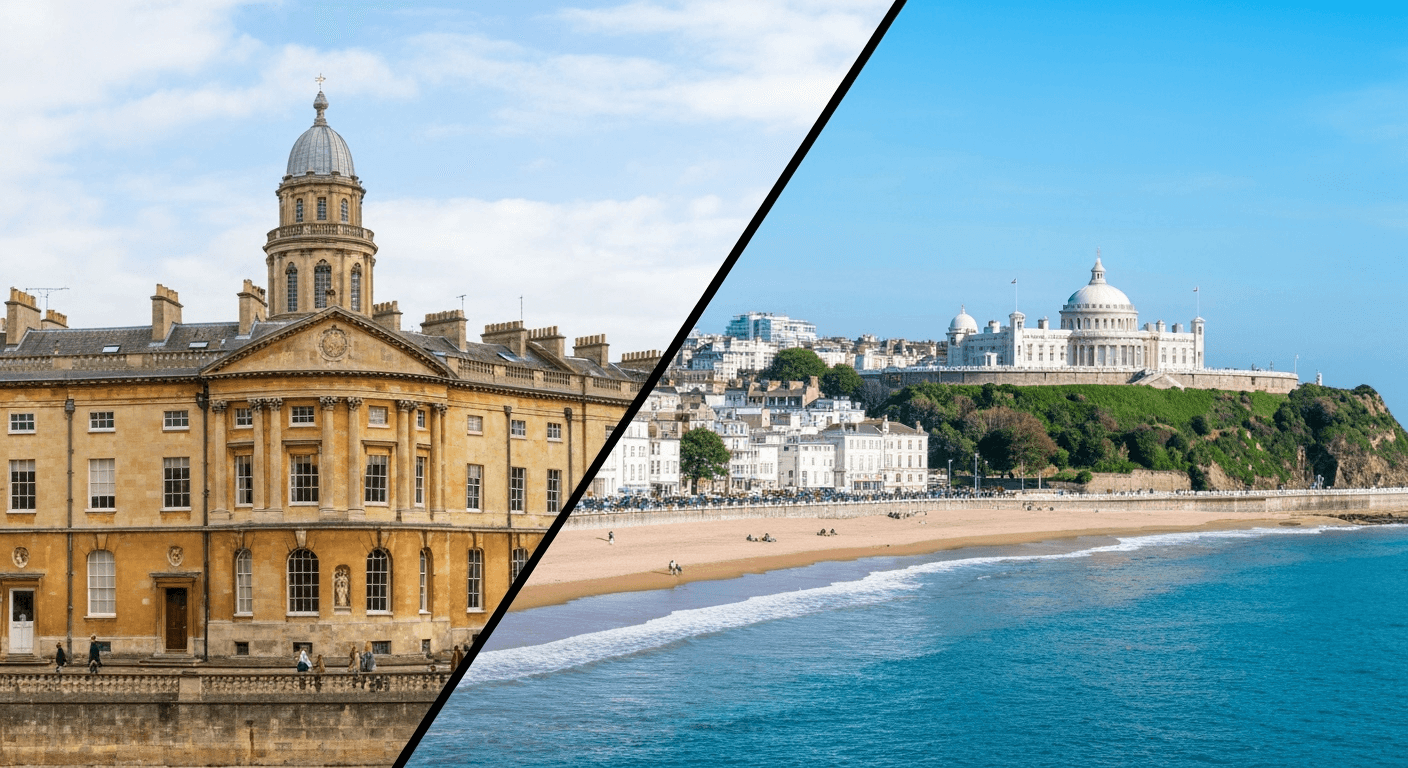
Better still, let most of the group skip the car altogether. Three of our destinations do this brilliantly: Bath is ninety-odd minutes from London by rail with houses walkable from the station, Brighton is the easiest car-free party weekend in Britain, and York opens up Yorkshire on a fast East Coast line. One designated driver collects the luggage and the big shop; everyone else gets a table seat and a tin of gin. That’s not a sacrifice — it’s a better journey.
Ask the owner, don’t assume the listing
“Eco-friendly” gets used loosely across the whole holiday industry, and a group house listing is no exception. Rather than trusting a green leaf icon, ask the owner directly: how is the house heated, and is any of that from a heat pump or solar rather than oil or gas? Is there an EV charging point, or an outdoor socket that can be used to trickle-charge overnight — our guide to UK group houses with EV charging covers what to ask and why the answer varies so much between rural properties. Is recycling collected and sorted, and where does food waste go? None of this is standardised, and owners who have genuinely invested in it are usually glad to be asked, because it lets them explain rather than rely on a badge. It is also worth asking about laundry — whether towels and bedding are changed as standard mid-stay for a longer booking, since a group that does not need a mid-week change can simply say so and save an unnecessary wash.
Shop like a local, because you are one
For a weekend, you live there. So skip the supermarket run-and-dash and use the village butcher, the farm shop, the Saturday market. The food is genuinely better — a farm-shop breakfast for sixteen is a different meal from its supermarket cousin — and the money lands in the community whose lanes you’re parking in. Rural tourism only works long-term if the villages hosting it see some of the spend; where you buy the sausages is a small vote on that. If you would rather someone else did the cooking, a private chef who sources locally can do the same job for a big group, and our group house meals and catering guide covers how to brief one.
Activities that already suit a lighter footprint
The best low-impact group activities are also, conveniently, some of the best group activities full stop: walking straight from the door rather than driving to a trailhead, cycling, wild swimming where it is safe to do so, and an evening that stays at the house rather than requiring a taxi into town. Our group houses for walkers and hikers covers what to look for if that is the shape of your trip, and honestly, a weekend built around one long walk and one long dinner tends to need fewer car journeys than one built around ticking off attractions. Foraging walks, cookery sessions using what is genuinely in season, and stargazing away from town lights also work well for a group that wants to be outside without organising transport to a ticketed attraction — ask the owner what is available locally, since provision varies enormously by region and by season.
Choose a destination the group can actually reach
The single biggest travel decision most groups get wrong is picking a destination that suits whoever suggested it first, rather than the group as a whole. If most of your group lives within a couple of hours of the Cotswolds or the Peak District, choosing that over somewhere further afield cuts total travel considerably before anyone has thought about cars versus trains. Our Cotswolds houses and Derbyshire and Peak District houses both sit within reach of several major cities, which is worth weighing against a prettier but more distant option.
Waste and single-use extras
A big group generates more rubbish than any one household expects, and disposable plates, cups and decorations add up fast over a weekend. Bring reusable cups and proper crockery where the house does not already provide enough for the full group, and ask the owner how recycling and food waste collection actually works locally — rural collection schedules vary, and a house that only has one bin for everything is a sign to bring your own sorting. It is a small thing, but it is one entirely within the group’s control, unlike most of what gets marketed as an eco feature. The same logic applies to the big shop: one large delivery or one trip in the fullest car beats several separate supermarket runs by different members of the group, and it usually saves money as well as journeys.
What I won’t claim
You’ll notice no carbon percentages in this piece, and no claims about specific properties holding eco certifications we have not verified. I don’t have verified footprint numbers for house stays versus hotel stays, and I’d rather tell you the honest, obvious truths — share cars, take trains where the destination allows it, buy locally, ask the owner rather than trust the listing — than dress marketing up as science. Beware anyone in this industry quoting suspiciously precise savings, and be equally sceptical of any group house claiming blanket “eco-rated” status without explaining what that actually means for the specific property.
A practical fix: appoint a transport captain when you book, not the week before. Car-sharing happens when someone owns the spreadsheet; left to the group chat, the group arrives in nearly as many cars as people every single time.
How we counted
The figures above come from reading every one of the 33 houses live on Group Escape Houses on 4 September 2026 and recording what each owner states in their own listing. Where an owner has not stated something we count it as not stated rather than assuming it. Price figures exclude one listing whose advertised weekend total is clearly a nightly rate, which would otherwise drag the median down; that leaves 32 houses in the price counts and 33 in every other count. It is a small sample and we say so plainly — but it is the exact set of houses you are choosing from here, counted on a stated date rather than described in round numbers.
Sources
- Group Escape Houses — our own count of every house live on this site on 4 September 2026
These are counts of live listings, not estimates or projections. We recount them when the inventory changes. Prices are the owner’s advertised weekend total for exclusive use of the whole house.
Frequently Asked Questions
What makes a group house genuinely eco-friendly?
Are eco-friendly group houses more expensive?
Can I find group houses with EV charging?
What sustainable activities work well for large groups?
Do eco-friendly group houses have hot tubs?
How do I actually reduce the footprint of a group holiday?
How do I book an eco-conscious group house?
Does choosing a closer destination actually make a difference?
Share this post